Where it started
I sketched constantly as a kid. Garfield, golf courses, logos, airplanes. Not because I wanted to fly one, but because the form fascinated me. How things look. How they work. The shape of an idea before it’s real.
Somewhere in there I got hold of a Commodore Amiga with an F-18 flight game on it. The graphics blew me away.
I didn’t have the language for it yet, but the pull toward visual technology started right there.
An unlikely start
Mechanical engineering, University of Louisville. Not a straight line. I followed what pulled at me more than any plan.
My first real test came as a co-op at Henry Vogt Machine Company. My boss handed me a PLC automation project with zero instruction.
I couldn’t even spell PLC.
Within a few weeks I’d built automated test stands and picked up welding, plumbing, relay ladder logic, refrigeration, automation: whatever the problem needed. Give me something defined and I’ll go after it. That’s just how I’m wired.
I moved through GE Supply, Raque, GE Fanuc: technical sales, project management, program management. Every move followed a pull, not a five-year plan. And early on, in my first job, I already knew:
Whatever I was actually built for wasn’t in the want ads.
In my late twenties I went through a round of professional assessments. The IQ result surprised me. But the one that stuck was a separate profile that came back technical, artistic, and enterprising, all three, fully loaded. The instructor running it stopped and said she’d never seen that combination before.
I filed it away. I didn’t know what to do with it yet.
The rest of this story is basically me catching up to what that assessment already knew.
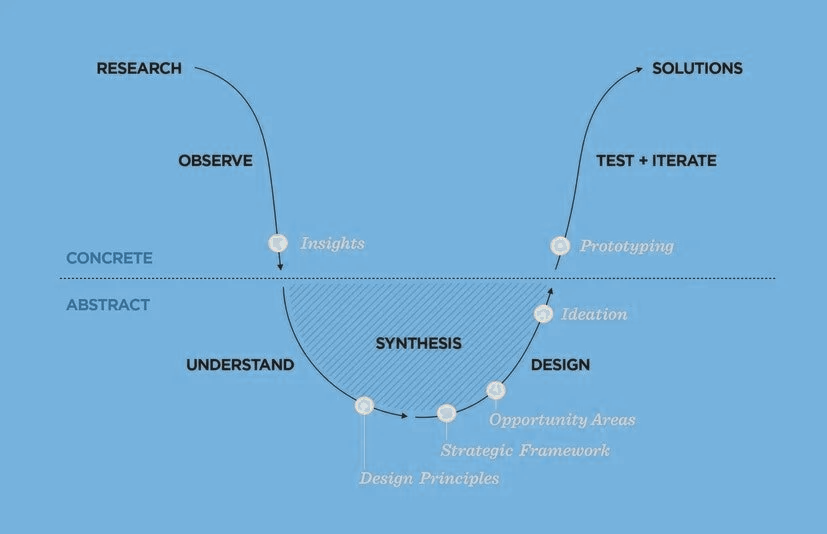
At 36 I joined GE Appliances’ innovation department. At 38 I found myself working alongside IDEO, one of the best design thinking firms in the world, on a real innovation project.
That’s where I got the word. Synthesis. Not a new skill, a name for the one I already had.
IDEO also handed me something I still use on every project, twenty-some years later: the target customer interview. Sitting with someone and listening closely enough to hear what they’re actually telling you, not just what they’re saying out loud. The real problem is almost always hiding inside that conversation somewhere. Synthesis is what pulls it out.
That’s where I got the word. Synthesis. Not a new skill, a name for the one I already had.
I held my own in that room. Not because anyone had trained me for it. Because the wiring was already there. I just didn’t have the words yet.
2008. Age 39. GE Appliances. Five words:
“We are going to have to let you go.”
Most people panic at that sentence. Some part of me recognized it as the door I’d been too reluctant to open myself.
I’d already been teaching myself rendering software that year, already blown away by what it could do. When the layoff landed, the direction was obvious. Left brain and right brain, finally in the same job. Technical precision and creative instinct: something no job title I’d held had ever had room for both at once.
No design background. No animation training. No clients. I taught myself texturing, lighting, professional photography, videography, composition, layout, mostly through YouTube and the MODO software community, at whatever hour I could find.
My first real project was a folding plastic wheelchair. Three months of work, a thousand dollars, and more help from the MODO community than I’ll ever fully be able to repay. When it was done, I was prouder of it than the price tag would suggest.
Not long after, the CEO of MODO introduced me at a dinner at Solidworks World. He called me a CG Artist.
He called me a CG Artist. It felt right.
A few years later, Fortune 500 companies were winning innovation awards at CES using work that came out of my studio. One innovation manager put it simply:
We couldn’t have done it without McCrorey Digital.
I don’t just render what I’m told to render. I understand the mechanism first: the physics, the engineering, the actual reason the product works the way it does. And I build the visual outward from that understanding, not the other way around.
Every project follows the same order:
- Understand the technology, deeply enough to know what the brief gets wrong.
- Find the audience’s frame of reference: how they think, what they already believe, what has to shift.
- Build the communication asset, structured around the viewer, not the product. Connect before you impress.
- Add cinematic quality, production value on top of a clear story, never instead of one.
Reverse that order and you get a beautiful video nobody understands. Get it right and you get the moment someone finally says oh, now I get it.
The final animation is never the hardest part of the work. The hardest part is helping a room realize they’re not actually aligned yet.
I’ve spent twenty-plus years in that same room, in different forms, for different clients.
I didn’t invent this. I noticed I had it, and I’ve spent my career finding out how deep it goes.
McCrorey Digital is where it started. It’s not where it ends.