
In the last piece I wrote about Assumed Alignment – the quiet, invisible condition where everyone on a team believes everyone else understands, so nobody checks.
Today I want to talk about what happens next.
Because Assumed Alignment doesn’t stay quiet forever. It gets louder as the project accelerates. It just disguises itself as something else entirely.
It disguises itself as momentum.
The Momentum Trap: the faster a team moves, the more socially impossible it becomes to stop and ask whether everyone is actually seeing the same thing.
Here is how it plays out.
The launch date is set. The calendar is packed. Deliverables are flying. People are working hard and moving fast and checking things off lists. From the outside it looks like a team firing on all cylinders.
But underneath that momentum, the misalignment that started early is now compounding quietly. Every decision made on top of a misunderstood foundation makes the foundation harder to correct. Every asset built, every message crafted, every sales deck assembled – all of it is adding weight to a structure that was never fully solid.
And nobody says anything. Not because they don’t sense it. Sometimes they do.
They don’t say anything because of what it would cost to say it.
Stopping a fast-moving team to say “I’m not sure we’re aligned on what this product actually does” is one of the hardest things anyone can do in a professional setting. It feels like pulling the emergency brake. It feels like being the problem.
So instead, people do what smart, well-intentioned people do under pressure. They adapt. They fill in the gaps with their own interpretation. They make reasonable assumptions and keep moving.
Engineering assumes marketing understands the core mechanism. Marketing assumes sales can figure out the pitch from the brief. Sales assumes the product does what the website says it does. Everyone assumes leadership has a clear view of all of it.
Each assumption is understandable on its own. Together, they are a slow-motion collision.
I sat in on a product launch meeting once – brought in late, as I usually am – and watched a team walk through their go-to-market plan with complete confidence. The slides were polished. The messaging was tight. The timeline was aggressive but achievable.
Twenty minutes in, I asked a simple question.
“When a customer asks your sales rep why this product is better than the alternative, what does the rep say?”
The room went quiet.
Three people answered. Three different answers. None of them matched the product page we had just reviewed.
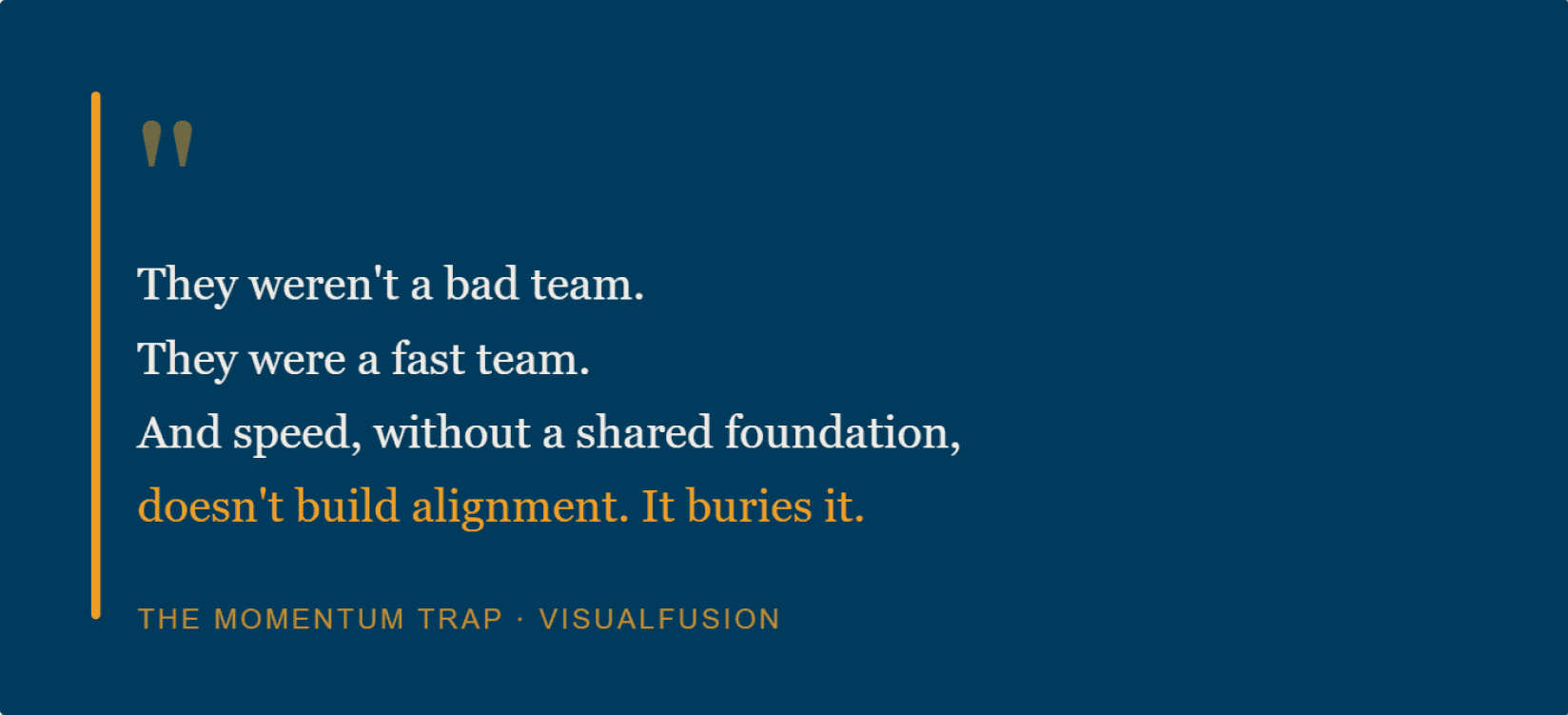
This is the Momentum Trap. Not that teams move too fast. Movement is good. Momentum is valuable. The trap is that momentum makes the cost of stopping feel higher than the cost of continuing – even when continuing means building further on a cracked foundation.
The telling sign is usually subtle. It shows up as a certain vagueness in how different people on the same team describe the product. Ask five people what makes it different and you get five slightly different stories. Nobody is lying. Everyone believes their version. That is exactly the problem.
By the time most teams realize this, they are deep enough into the launch that fixing it feels catastrophic. Reworking the messaging means reworking the assets. Reworking the assets means reworking the timeline. Reworking the timeline means difficult conversations nobody wants to have.
So a lot of teams don’t fix it. They ship what they have and hope the market sorts it out.
Sometimes it does. Often it doesn’t.
The antidote to the Momentum Trap is not slowing down. It is building a shared foundation before the momentum begins – so that when the team moves fast, everyone is moving in the same direction.
I call that moment Shared Zero. The first time everyone in the room sees the product the same way at the same time. It usually takes a few hours. The cost of not doing it is measured in months.
In the next piece I will write about what happens when neither of these things occurs – when Assumed Alignment feeds the Momentum Trap all the way to launch, and the bill finally arrives.
I call that the Silence Tax. And it is the most expensive thing most product teams never see coming.
0 Comments